✈ TheCantMiss Take
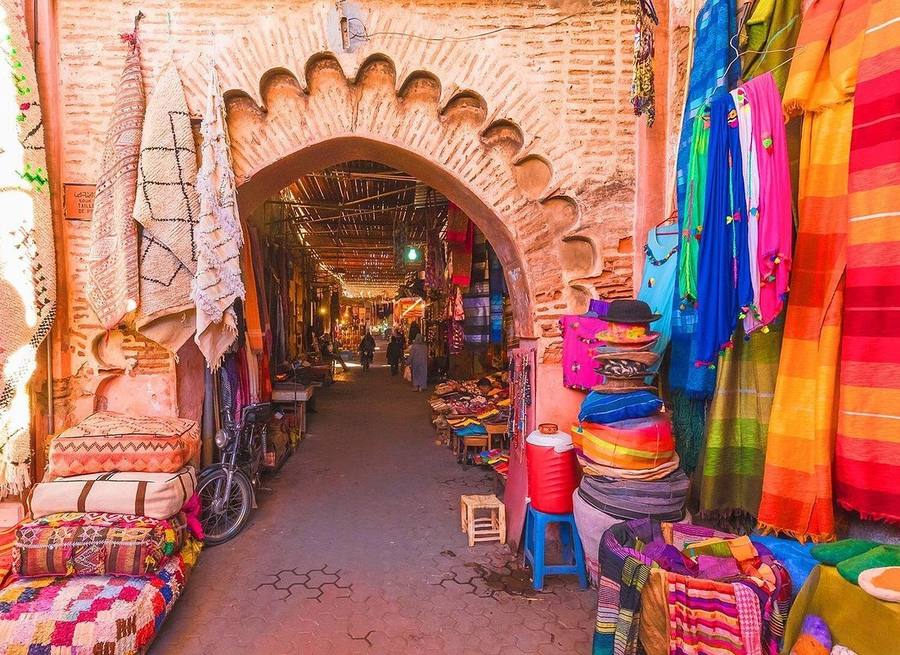
Morocco is the most sensory-dense travel destination in the world. The Marrakech medina assaults you with smell, sound, colour, and heat simultaneously, and that's before you've turned the first corner. The Sahara at night — no light pollution, 10,000 stars, the silence of 9 million square kilometres of desert — is one of the most completely humbling environments a human can be in. And Essaouira's Atlantic coast, where the wind never stops, is one of the finest kitesurfing destinations on Earth. Three places, nine days, three completely different Moroccos.
This is the best Morocco itinerary for first-time visitors — Marrakech for the medina, souks, hammam, and a riad rooftop dinner; the Sahara for a camel trek and desert camp under the stars at Erg Chebbi; and Essaouira for kitesurfing the Atlantic. Nine days, three utterly distinct experiences, all connected by road through some of the most dramatic landscape in Africa.
🕌
Marrakech
Fly into Marrakech Menara (RAK) · Djemaa el-Fna square · 9,000-alley medina · Souks · Majorelle Garden · Hammam
Days 1–4
🎫 Marrakech Experiences
🎫 Powered by Viator · Affiliate links support this site
The Marrakech medina was founded in 1070 AD and has been a UNESCO World Heritage Site since 1985. It is nearly a thousand years old and has never been modernised — the same dyers, tanners, coppersmiths, and spice merchants who operated here in the 12th century still do, in the same locations, using the same techniques. The 9,000-alley network is genuinely disorienting without a guide, and genuinely extraordinary with one.
The Djemaa el-Fna square at dusk is one of the great travel spectacles — snake charmers, acrobats, henna artists, storytellers performing in Darija to packed circles of locals, and the greatest open-air street food theatre on Earth as hundreds of food stalls materialise simultaneously at sunset. The Majorelle Garden — Yves Saint Laurent's blue masterpiece in the new city — is the medina's quiet counterpoint, worth the taxi ride.
⭐ Why It's Worth It
The Marrakech medina is one of those places that makes you feel like you have genuinely stepped into a different century. The leather souk smells like tannin and history. The spice souk looks like a painting. The Djemaa el-Fna at night feels like the whole city is performing for itself rather than for tourists. Go with a guide the first time — then go alone.
Book Tour →
The hammam is Morocco's oldest social institution — a communal bathhouse that has been the centre of neighbourhood life for over a thousand years. A traditional hammam session begins in the steam room, where the heat opens your pores and your muscles begin to let go of something you didn't know they were holding. Then comes the kessa scrub — a rough mitt worked across every surface of your skin until the dead cells roll off in grey ribbons. Then black soap (beldi), made from olives and pressed into something between a paste and a cream. Then ghassoul clay mask, applied and left. Then argan oil massage.
The result is skin that feels entirely renewed. The experience takes 1.5–2 hours and costs between $20 and $60 depending on whether you go to a local neighbourhood hammam or a riad spa version. Both are excellent. The local version is more authentic and considerably cheaper.
Includes
Scrub, soap, clay, oil
⭐ Why It's Worth It
A proper hammam is one of the most complete physical experiences Morocco offers. The kessa scrub alone is worth the trip — the amount of dead skin that comes off is genuinely alarming and the skin underneath is genuinely extraordinary. Do it on Day 2, after the medina has covered you in dust and heat. You'll leave feeling like a new person.
Book Tour →
A Marrakech riad rooftop at sunset is one of the finest dining settings in the world. The riads — traditional Moroccan houses built inward around a central courtyard — are invisible from the street, which makes emerging onto a rooftop terrace above the medina feel like a reveal: the whole city spreading out in every direction, the Koutoubia minaret cutting the skyline, the Atlas Mountains faintly visible to the south, the call to prayer beginning from seventeen directions simultaneously as the light turns amber.
The food — slow-cooked lamb tagine with preserved lemon and olives, pastilla (pigeon pie with cinnamon and almonds), harira soup, Moroccan salads, fresh msemen flatbread — is the finest expression of one of the world's great cuisines. Lanterns everywhere. The noise of the medina rising from below. A genuinely exceptional evening.
Cuisine
Traditional Moroccan
⭐ Why It's Worth It
The combination of the rooftop setting, the food, and the moment the call to prayer starts from every direction at once as the sun goes down over the Atlas is one of those travel memories that doesn't fade. Book it for your last night in Marrakech — it's the perfect send-off before the Sahara.
Book Direct →
🏨 Where to Stay — Marrakech

Riad Kniza, Marrakech
⭐⭐⭐⭐⭐ · ~$186/night
18th-century riad owned by the same Moroccan family for nearly 200 years — rooftop pool, hammam, and a private museum of Moroccan antiques attached. Deep inside the medina, with a guide to navigate you in and out. One of the finest small hotels in Africa.
Book on Booking.com →
🚐
Marrakech → Sahara Desert (Erg Chebbi)
Private driver or organised tour, ~8–9 hours via the Tizi n'Tichka pass and Draa Valley. The drive itself is one of Morocco's finest — through the High Atlas, past kasbahs, date palms, and oasis towns that haven't changed in centuries. Most visitors do this as part of a 2-day guided desert tour that handles all logistics.
🏜️
Sahara Desert — Erg Chebbi
Merzouga · 150m ochre dunes · Camel trek at sunset · Desert camp under the stars · Sunrise from the highest dune
Days 5–6
🎫 Sahara Experience
🎫 Powered by Viator · Affiliate links support this site
The Erg Chebbi dunes at Merzouga are among the most extraordinary landscapes on Earth — 150-metre ochre dunes rising from flat desert, shifting shape in the wind, completely silent. You arrive in the late afternoon, mount a camel, and ride for an hour into the dunes as the light turns the sand from gold to deep orange to red. At the private camp, there is Berber music and tea over a fire, a slow dinner of tagine, and then — after everyone else has gone to sleep — a sky so dense with stars that the Milky Way casts a faint shadow.
Wake before dawn, climb the highest dune, and watch the sunrise reverse the colours again: from grey to pink to gold to the blinding white of the full Saharan morning. The whole experience — from camel ride to sunrise — lasts about 16 hours and is one of the finest 16 hours available to a traveller anywhere on Earth.
Location
Erg Chebbi, Merzouga
Duration
Overnight (sunset→sunrise)
⭐ Why It's Worth It
Sleeping in the Sahara is one of those experiences that permanently recalibrates your sense of scale and silence. The stars are not like anywhere else. The dunes in the morning light are not like anywhere else. The camel is exactly as uncomfortable as expected and completely irrelevant to how extraordinary the whole thing is.
Book Tour →
🏨 Where to Stay — Sahara Desert

Luxury Desert Camp — Erg Chebbi
⭐⭐⭐⭐ · ~$150–250/night (dinner & breakfast incl.)
Private tented camp in the dunes, 30–45 minutes by camel from Merzouga — en-suite bathrooms in the tents, Berber carpets, fire pit, and a silence you won't find anywhere else. Most good desert tour operators include accommodation; book a reputable operator rather than the cheapest option.
Search Desert Camps →
🚐
Sahara → Essaouira
Private driver or organised transfer, ~8 hours via Ouarzazate and the Souss plain. Long but rewarding — the landscape shifts from desert to mountain to the first smell of Atlantic salt. Supratours buses also run from Ouarzazate to Essaouira (~5 hours) for those travelling independently.
🌊
Essaouira — Atlantic Coast Kitesurfing
3 hours from Marrakech · Consistent Atlantic wind · UNESCO medina · Gnawa music · Best kitesurfing in Morocco
Days 7–9
🎫 Essaouira Experience
🎫 Powered by Viator · Affiliate links support this site
Essaouira sits at the point where the Canary Current sweeps in from the Atlantic and meets the Moroccan coast — producing a reliable, powerful wind called the Alizé that blows 300 days a year and makes this one of the finest kitesurfing destinations on Earth. The beach is 5km of flat sand with consistent side-shore wind, shallow water for beginners, and enough power for experienced riders to get serious air. International kite schools operate year-round with equipment for all levels.
The town itself — a UNESCO-listed medina of blue-shuttered whitewashed houses, ramparts over the Atlantic, and the constant sound of Gnawa music from the squares — is one of Morocco's most immediately loveable places. Relaxed where Marrakech is intense, cool where the interior is hot, and completely its own thing. Three days here, alternating between the kite beach and the medina, is the perfect final act of any Morocco itinerary.
⭐ Why It's Worth It
Kitesurfing at Essaouira is the perfect contrast to everything that came before on this itinerary. After four days in the medina heat and two nights in the desert silence, the cold Atlantic wind and wide open beach feel genuinely liberating. Even if you've never touched a kite, three days of lessons here will have you riding. The combination of world-class wind and the most beautiful medina in Morocco makes Essaouira unmissable.
Book Lessons →
🏨 Where to Stay — Essaouira

Boutique Riad — Essaouira Medina
⭐⭐⭐⭐ · ~$100–180/night
A riad inside the Essaouira medina — whitewashed walls, blue doors, rooftop terrace with Atlantic views, and a 5-minute walk to the kite beach. Essaouira has excellent boutique accommodation at significantly lower prices than Marrakech.
Search Essaouira Riads →
🗺️ Morocco Practical Tips
Getting around: Private drivers are affordable and the best way to connect Marrakech, the Sahara, and Essaouira. A 3-city private driver for the whole itinerary costs $300–500 total and is worth every dirham. CTM and Supratours buses are reliable for budget travellers.
Bargaining: Expected in the souks — start at 30–40% of the asking price and meet in the middle. Not appropriate in restaurants or riads. Always agree on taxi prices before getting in.
Dress: Morocco is a conservative Muslim country. Shoulders and knees covered outside of beach areas — particularly important in medinas and mosques. Women are not required to cover their hair.
Currency: Moroccan Dirham (MAD). Cash is essential — many riads, hammams, and souk vendors don't take cards. ATMs are reliable in Marrakech and Essaouira.
Best months: March–May and September–November for Marrakech and the Sahara. The Sahara is extremely hot June–August (45°C+). Essaouira is good year-round — the Alizé wind blows regardless of season.